
Dafna Maimon (b. 1982, Porvoo, FI) explores how and to what effect embodied knowledge is disregarded in contemporary society. Her work encompasses performance, video, drawing and immersive installation. Through fictional and semi-autobiographical narratives, Maimon’s humorous work explores the human narrative and its main protoganist: the human body. She surveys how humans handle recollections, stereotypes, abjection and traumatic experiences. In particular, her work deconstructs patriarchal structures and plays with them through exaggeration, subversion and re-contextualization.
Maimon’s work has been featured in institutions and art spaces that include Kiasma Museum of Contemporary Art, Helsinki (2025); Museum of Contemporary Art Antwerp (2024); and Helsinki Biennial (2021).
Maimon holds a BFA from the Gerrit Rietveld Academy and an MFA from the Sandberg Institute, Amsterdam. She has recently completed a residency at Pro Artibus Villa Snäcksund (Ekenäs, Finland (2023–2025). Maimon is a founding member of the artist collective Conglomerate. She lives and works in Berlin.
Portrait: Finnish National Gallery / Pirje Mykkänen
Killing Descartes, Or a Cave of One's Own. Essay by Elene Abashidze, Launch Pad LaB Visiting Curator, Spring 2026.
work in progress by Dafna Maimon
"Now, here's a cracker;
Should we be appalled or inspired?
Scientists have discovered that
sea slugs can regrow their entire bodies after self-decapitating.”
- Excerpt from Leaky Teeth (2021), single-channel 4K video, 31 min. 08 sec.
Film, performance, installation, and drawing comprise the Berlin-based artist Dafna Maimon's practice. Maimon is interested in a holistic approach to the body and its organs. This is clearly manifested in the trilogy of her previous films, in which the subject of the body unfolds through its various organs and systems, including the intestines, teeth, ears, and others. This is not to say that the mind is absent; rather, it no longer appears to be fully in control. Often zooming in and out of the body, Maimon invites the viewer to take a closer look at what we, as omnivores, are made of. While only hinted at in her earlier works, decapitation occupies the central place in her current work in progress.
Killing Descartes, Or a Cave of One's Own is the working title of a film with an intended duration of approximately thirty minutes. Shot on various cameras during the Launch Pad Lab residency in May and June 2026, the film resembles a B-movie—a low-budget commercial motion picture whose aesthetics have since become associated with the celebrated American filmmaker John Waters, who transformed this once "lesser" Hollywood form into an influential component of contemporary culture.
The plot revolves around two fictional female characters, both named En, who are trapped in a loop of failed attempts to murder the father of Western philosophy, René Descartes.
The name En derives from a dream Descartes recorded in 1618, in which Monsieur N attempted to offer him a gift—a melon—but failed to reach him. Maimon twists this dream, replacing Monsieur N with her female protagonists. The two Ens meet when one En is in the middle of recording an interview about her experience at the artist residency. At that moment, another En, dressed in medieval clothing, appears after a failed journey through time and space. Their trajectories collide, and, much like in Artemisia Gentileschi's iconic painting Judith Beheading Holofernes (c. 1612–13) of the same era as Descartes, the film proposes that it takes two to decapitate power, with the pair standing for a community of assassins.
Rage and revenge are far less present in Maimon's interpretation than they are in Gentileschi's work. Instead, the artist focuses on the physicality of decapitation and the corporeality of its symbolism. Following the failed attempt, the protagonist uses whatever materials are available at the residency to produce multiple clay versions of Descartes's head. These are not portraits but representations of a head detached from its body. Clumsy at first, the sculptures gradually become more realistic, increasingly resembling Descartes himself with each successive attempt.
Repetitive by nature, Maimon's narrative suggests that failure, too, can form part of success, and that there is no single truth, no single point of entry, and no single model for achieving it. By reminding us that the mind belongs to the body just as the body belongs to the mind, the film returns to the artist's enduring interest in a holistic understanding of the body, while simultaneously challenging René Descartes's dualistic separation of mind and body.
The film occupies a special place within Maimon's practice. Whereas her earlier works describe the body's organs with remarkable precision, often bordering on the grotesque, Killing Descartes, Or a Cave of One's Own is almost entirely devoid of such representations. As the two Ens exchange places at the end of the film, forming a bond that becomes nearly indistinguishable, Maimon imagines a body stretched across both time and space.
There is a certain site-specificity in the film in progress and that is the close proximity to the village Descartes and the prehistoric caves of Font-de-Gaume, Les Gombarelles, Pech-Merle, Rouffignac and Lascaux. Both these sites have made their ways into the film. En visits the birthplace of the author of Cartesian coordinate system, while on her mission to discover how the philosopher is celebrated during the contemporary era. And the caves, interest in which already mark some of her pre-existing work, create a strong inspiration to her drawings and sketches for the film in progress. Even if not allowed to be filmed,these important cultural sites have created a starting point to Maimon’s imagination of En’s personal space to create. Referencing Virginia Woolf’s seminal 1929 extended essay “A Room of One’s Own”, Maimon takes the thought further to the prehistoric times, asking if we need to rewrite the history of feminism starting from the caves instead.
As the film continues to take shape during and after the Launch Pad residency, observing its development brings us back to Maimon's 2021 film Leaky Teeth, in which a radio DJ playfully poses an almost existential question: what if humans, like sea slugs, could decapitate themselves and regrow their own heads? What if Descartes's head were severed and regenerated today? Would he still think the same? In the end, we tend to forget that dubito ("I doubt") precedes cogito, ergo sum ("I think, therefore I am") in Descartes's philosophy.

Leaky Teeth, 2021/2025,
Expanded Cinema Installation / Short Film, 31 min, 670 x 350 x 250 cm, various materials,
dimensions variable, installation view Kiasma Museum of Contemporary Art, Symptoms 2025
Photography: Joe Clark
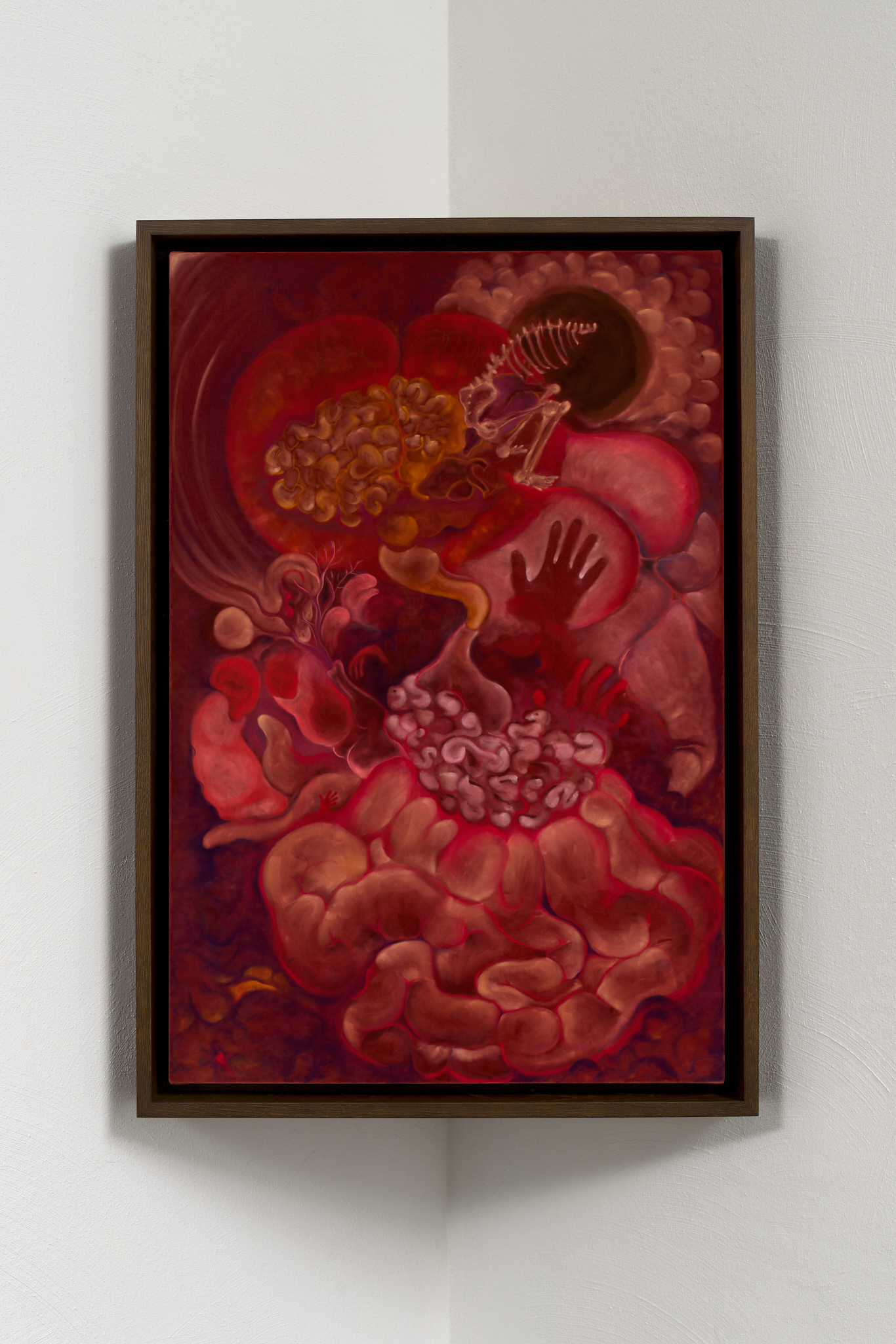
Trust, 2025,
120 x 80cm, Pastel Painting on Velvet, Installation view Kiasma Museum of Contemporary Art, Symptoms, 2025
Photography: Joe Clark

Indigestibles, 2021,
Installation view Helsinki Biennial, 2021
Photo Credit: Maija Toivanen
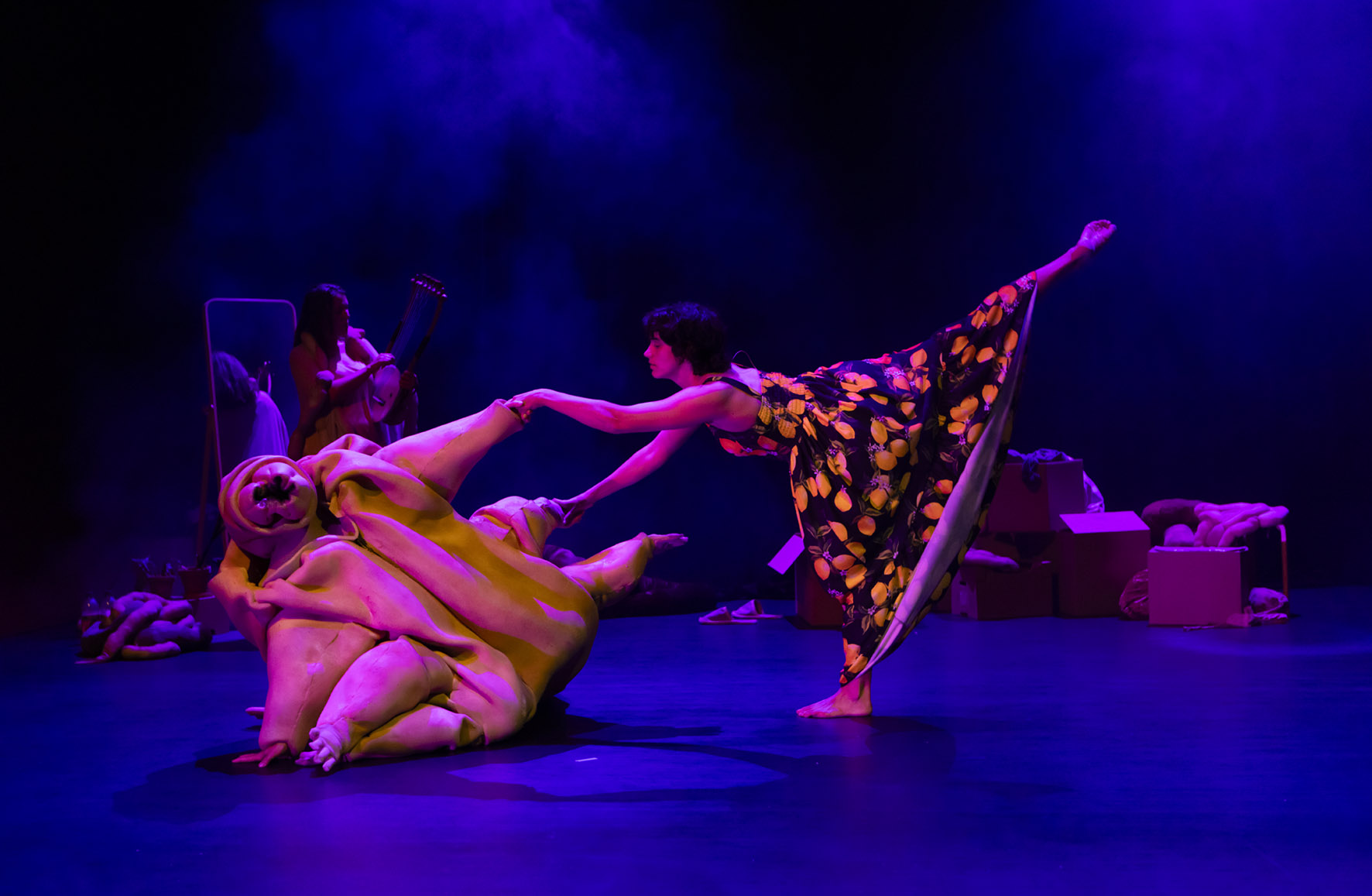
Interior Motives: The Musical, 2025
Performance 60 minutes, Kiasma Theatre
Photo Credit: Pirje Mykkänen, Finnish National Gallery of Art/ Kiasma
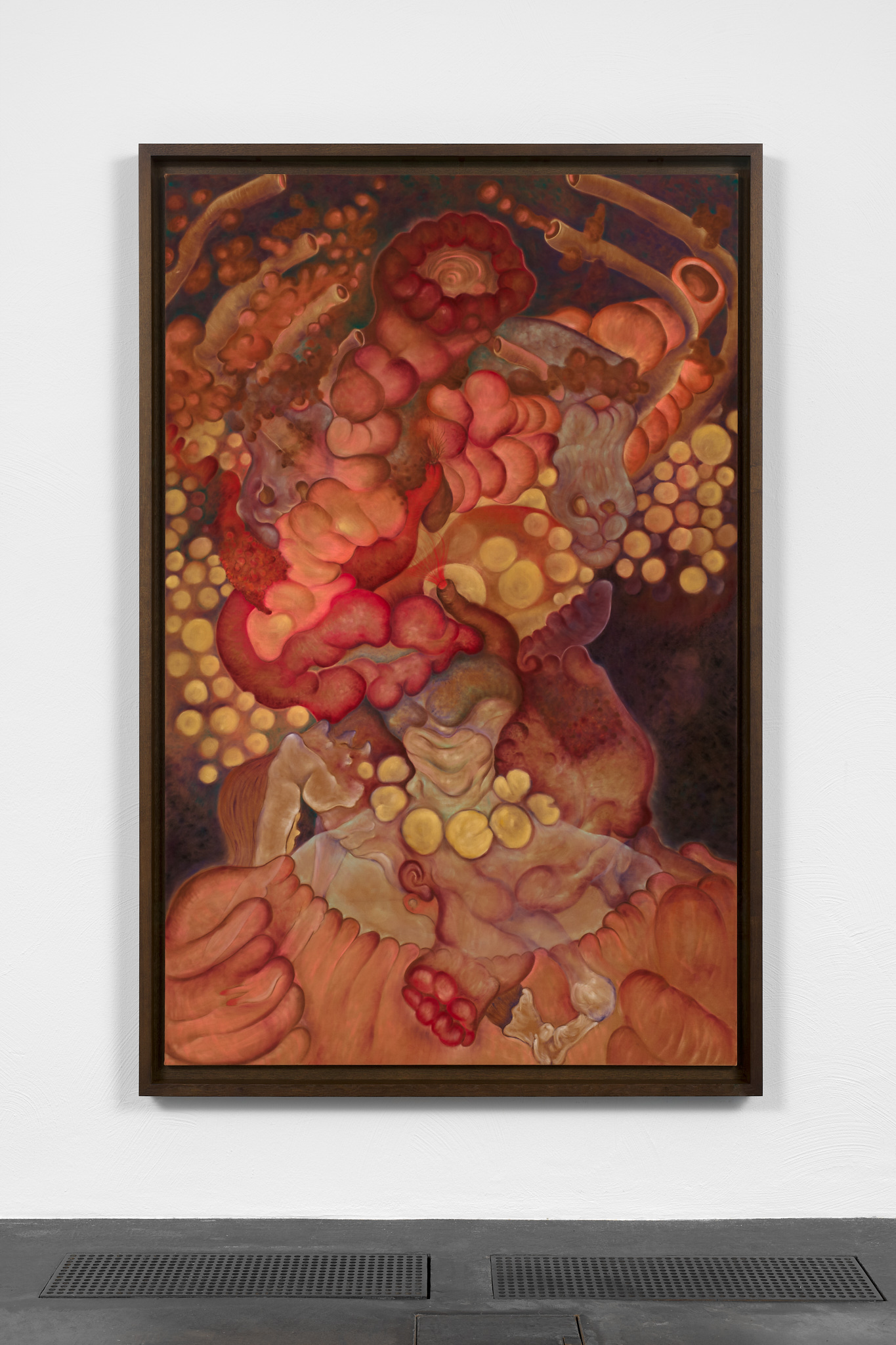
Initially a Portrait of Princess Elizabeth of Bohemia (1618-1680), 2025
Pastel Painting on Velvet, 220 x 140cm
Installation view Kiasma Museum of Contemporary Art, Symptoms, 2025
Photography: Joe Clark